AI Agents Are Starting to Pay: How Crypto Could Power the Machine Economy
AI agents are moving beyond chat and automation. With stablecoins, blockchain wallets and agentic payment infrastructure developing rapidly, machines could soon make payments without direct human intervention.
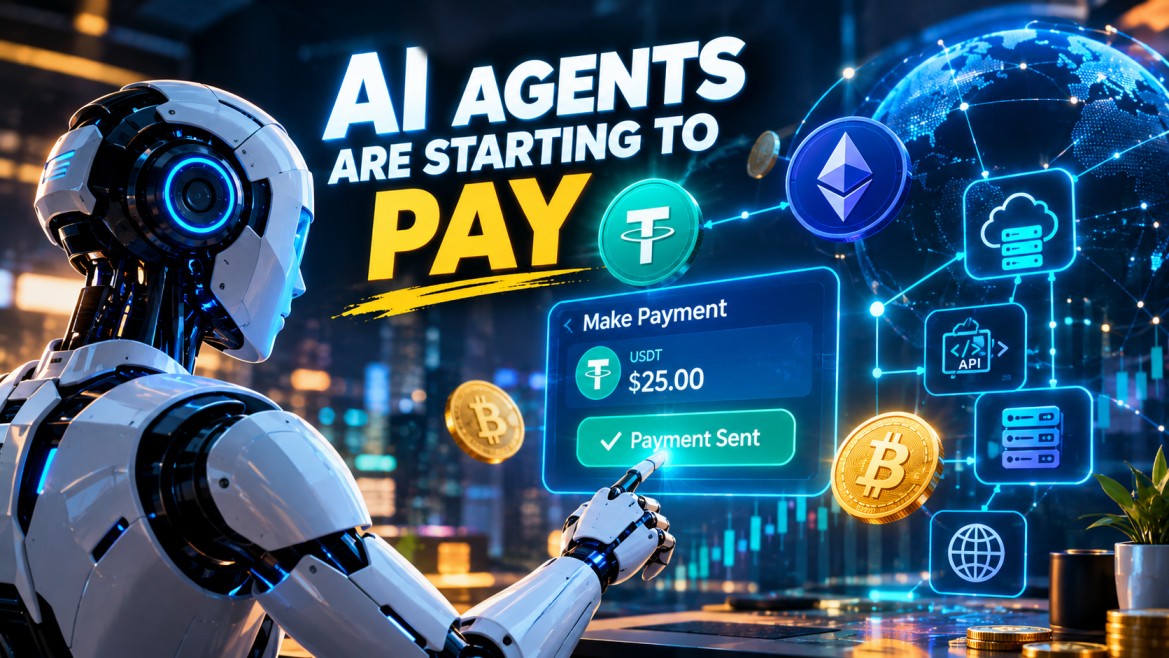
Artificial intelligence is entering a new phase in which AI agents can do more than generate text, analyze data or automate tasks. They are increasingly being designed to interact with financial infrastructure and potentially make payments on behalf of users and businesses.
This is creating a new intersection between AI agents and crypto, where blockchain networks and stablecoins could become payment infrastructure for machine-to-machine transactions.
What Are AI Agent Payments?
An AI agent is software capable of performing tasks with limited human intervention.
Imagine an AI agent that needs access to a premium database. Instead of waiting for a person to purchase a subscription, the agent could identify the required information, pay for access and complete the task automatically.
Crypto can make this model possible because blockchain transactions can be executed programmatically.
Stablecoins are particularly relevant because they provide digital assets designed to maintain relatively stable values, making them more practical for automated payments than highly volatile cryptocurrencies.
Why Are Stablecoins Important for AI Agents?
Traditional payment systems were primarily designed for humans.
Card payments, bank transfers and subscriptions often involve authentication, accounts, intermediaries and minimum transaction costs.
AI agents could require a completely different payment model.
An agent might need to make hundreds or thousands of very small payments for APIs, computing resources, datasets or digital services.
Blockchain-based stablecoin payments could potentially support these transactions with programmable wallets and automated settlement.
The Rise of the Machine Economy
The combination of AI and blockchain could create what is increasingly being described as a machine economy.
In this model, AI agents could purchase computing power, access information, pay other software agents and manage digital resources.
For example, an AI trading assistant could pay for market data, while another agent could automatically purchase cloud computing capacity when demand increases.
The important change is that the software itself becomes an economic participant rather than simply a tool controlled at every step by a human.
What Role Could Crypto Networks Play?
Blockchain networks could provide the payment and settlement layer for this emerging economy.
Smart contracts can define payment conditions, while wallets can allow agents to hold and transfer digital assets.
Stablecoins could handle the actual value transfer, while blockchain infrastructure provides transaction records and programmable settlement.
This could create demand for networks capable of handling large numbers of inexpensive transactions
What Are the Biggest Challenges?
The machine economy still faces major challenges.
AI agents need secure wallets, spending limits, identity systems and reliable ways to verify who they are paying.
There is also the problem of mistakes. An autonomous agent making an incorrect payment could potentially create financial losses without immediate human intervention.
Regulation, stablecoin infrastructure, cybersecurity and interoperability will therefore become increasingly important as agentic payments expand.
Could AI Agents Become a Major Crypto Narrative?
AI and crypto are increasingly moving from separate narratives toward overlapping infrastructure.
AI provides the autonomous decision-making layer, while blockchain can provide programmable ownership and settlement. Stablecoins can potentially connect the two through digital payments.
If developers successfully solve security, identity and payment-control problems, AI agents could become one of the most interesting new use cases for blockchain technology.
Final Thoughts
The next stage of crypto adoption may not be driven only by humans buying and selling digital assets.
AI agents could eventually become regular participants in digital economies, purchasing data, computing power, software and other services automatically.
For crypto, that creates a completely different use case: blockchain as payment infrastructure for autonomous software.
The technology is still developing, but the combination of AI agents, stablecoins and programmable payments could become an important part of the next generation of digital finance.
Disclaimer: This article is for informational and educational purposes only and does not constitute financial or investment advice. Crypto assets, stablecoins and AI-based financial applications involve market, regulatory, technology and security risks.