Hyperliquid Liquidation System Explained: How Leverage Risk Is Controlled
Hyperliquid’s liquidation system is designed to protect the platform and traders when leveraged positions become undercollateralized. Here’s how margin, mark price, HLP and auto-deleveraging work together.
What Is Liquidation on Hyperliquid?
Trading perpetual futures with leverage allows traders to control a position larger than their deposited collateral. The problem is that losses can also increase rapidly when the market moves against the position.
This is where the Hyperliquid liquidation system comes into play.
When a trader’s available equity falls below the maintenance margin required to support an open position, the system can begin closing that position automatically.
The objective is to prevent an account from accumulating losses that exceed its available collateral and to help maintain the overall solvency of the trading system.
For leveraged traders, understanding this process is just as important as understanding entries, exits and funding rates.
How Does Hyperliquid Determine Liquidation Risk?
Liquidation is not simply based on the last price displayed on the trading screen.
Hyperliquid uses a mark price as an important reference for liquidation calculations. The mark price incorporates external market information along with the platform’s own market data, helping reduce the possibility that a temporary order-book movement alone triggers an unnecessary liquidation.
The closer a position gets to its liquidation level, the smaller the trader’s margin buffer becomes.
A highly leveraged position naturally has a much smaller buffer than a position using lower leverage. This means even a relatively small market movement can create significant liquidation risk.
What Happens When a Position Becomes Liquidatable?
Once a position falls below the required maintenance level, Hyperliquid can begin the liquidation process.
The system can send market orders to reduce or close the position. Larger positions may be handled progressively rather than being dumped into the order book all at once, helping reduce the potential impact of a very large forced sale.
This distinction matters because liquidation is not necessarily a single instant event. Depending on the size and condition of the position, the process can involve multiple stages.
The Role of HLP in Hyperliquid Liquidations
One of the most important parts of the system is HLP, or Hyperliquidity Provider.
HLP provides liquidity across Hyperliquid and can also act as a backstop for positions that cannot be handled normally through the order book.
In a backstop liquidation, the vault can take over an undercollateralized position. The position is then managed according to the protocol’s liquidation mechanisms.
This creates another layer between an individual trader’s losses and the wider trading system.
HLP is therefore more than a conventional liquidity pool. Its activities can include market making and handling liquidation-related risk.
What Is Auto-Deleveraging?
Hyperliquid also has Auto-Deleveraging (ADL) as a deeper risk-control mechanism.
ADL is designed for extreme situations where normal liquidation processes and available backstops are not sufficient to resolve a position without creating bad debt.
In such circumstances, positions on the opposite side can be reduced according to the protocol’s ADL rules.
Because ADL can affect traders who are not being liquidated themselves, it represents an important risk mechanism for users trading with significant leverage
Why Liquidation Cascades Can Be Dangerous
A major market move can trigger multiple leveraged positions at the same time.
For example, a sharp decline in an asset can liquidate highly leveraged long positions. Those forced closures can add selling pressure, potentially pushing prices lower and causing additional positions to become liquidatable.
This creates what traders commonly call a liquidation cascade.
The effect can be particularly significant in markets with high leverage, concentrated positions or limited liquidity.
How Traders Can Reduce Liquidation Risk
The easiest way to reduce liquidation risk is not to rely on the liquidation system in the first place.
Traders can consider several risk-management practices:
* Use lower leverage and maintain a larger margin buffer.
* Avoid putting an excessive portion of available capital into one position.
* Understand the difference between isolated and cross margin.
* Monitor mark price rather than watching only the last traded price.
* Consider predetermined exit levels instead of waiting for forced liquidation.
* Be especially cautious with highly volatile or less-liquid markets.
Leverage can increase the potential return of a successful trade, but it also reduces the amount of price movement required to create a major loss.
Hyperliquid Liquidation System: Final Takeaway
The Hyperliquid liquidation system uses multiple layers of risk management rather than relying on a single mechanism.
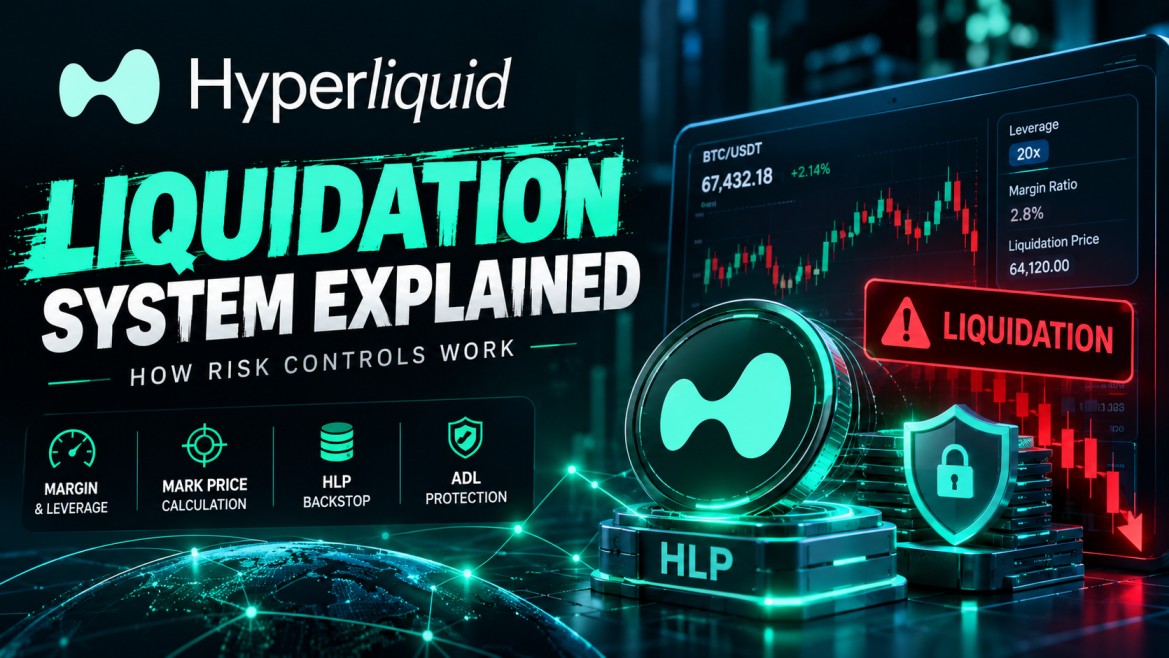
Maintenance margin helps determine when a position becomes vulnerable, mark pricing helps establish liquidation conditions, market-based liquidation attempts to close positions, HLP provides an additional backstop, and ADL exists as a last-resort mechanism during extreme conditions.
For traders, the biggest lesson is simple: liquidation should be treated as a risk-control mechanism, not as a trading strategy.
Understanding how the system works can help traders make better decisions about leverage, position sizing and margin before market volatility puts their account under pressure.
Disclaimer: This article is for informational and educational purposes only and does not constitute financial or investment advice. Perpetual futures and leveraged trading involve substantial risks, including rapid losses and forced liquidation. Always conduct your own research and understand the risks before trading