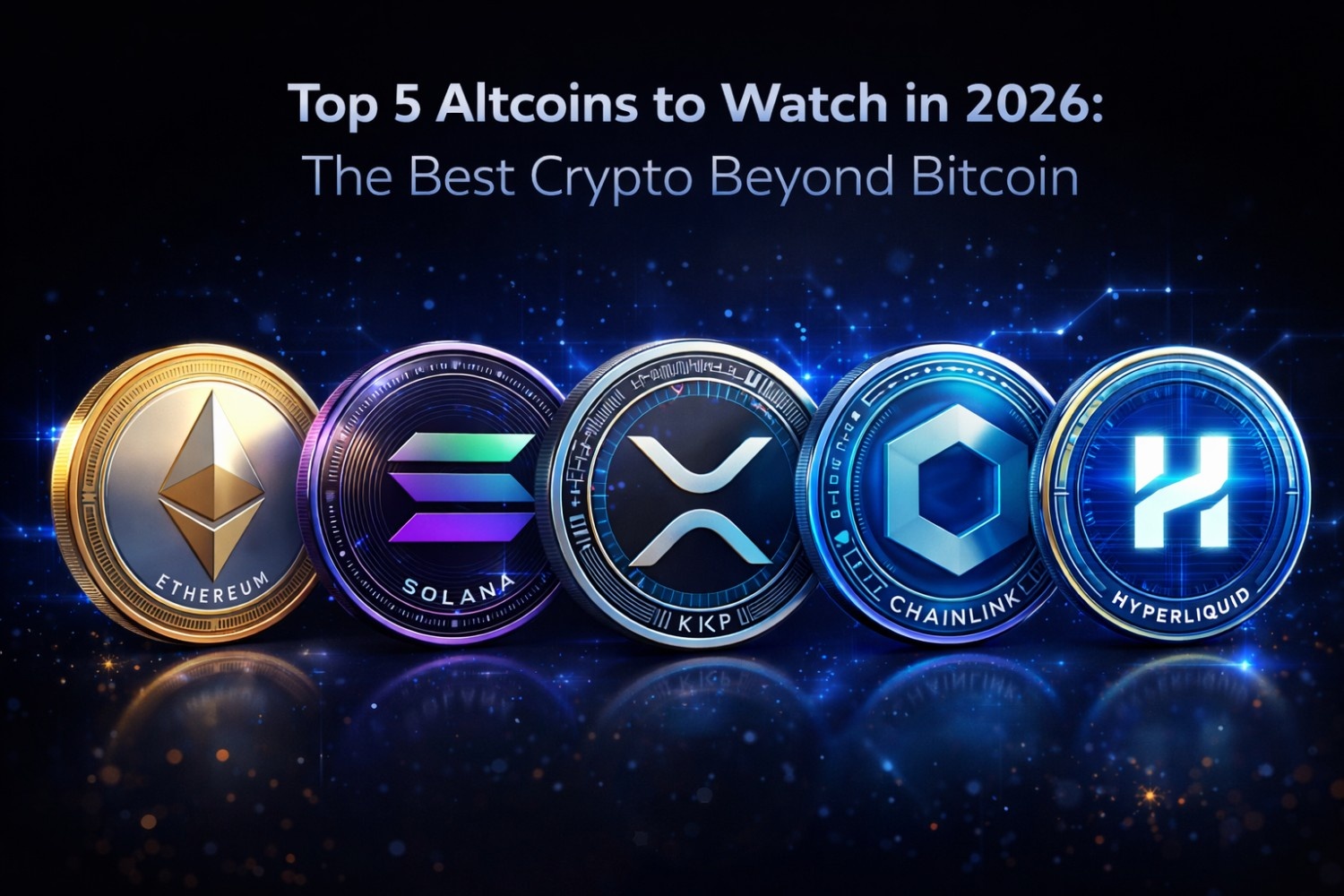
Top 5 Altcoins to Watch in 2026: The Best Crypto Beyond Bitcoin
In 2026 the altcoin market is rewarding projects with genuine utility, real protocol revenue, and growing institutional adoption, and these five assets stand out as the most compelling opportunities for investors looking beyond Bitcoin this cycle.
Bitcoin dominates the headlines, but it has never been where the highest percentage gains in crypto tend to materialise. Altcoins, everything outside Bitcoin, carry more risk, more volatility, and in the right market conditions, considerably more upside. The challenge has always been separating the projects worth holding from the thousands that will quietly fade to zero.
In 2026 the filter has become clearer. The altcoins with the most compelling risk-reward profiles are those generating real protocol fees rather than projects running purely on hype. Regulatory clarity, actual user adoption, and ecosystem durability have replaced narrative alone as the key drivers of sustained value. With that lens in mind, here are five altcoins that stand out heading into the rest of 2026.
One important reminder before diving in: altcoins are significantly more volatile than Bitcoin, and past performance never guarantees future returns. Position sizing and risk management matter more in this part of the market than anywhere else.
1. Ethereum (ETH)
Ethereum in 2026
Ethereum remains the undisputed foundation of decentralised finance, smart contracts, and the real world asset tokenisation movement that is reshaping traditional finance in 2026. No other blockchain comes close to matching its developer ecosystem, institutional infrastructure, or the sheer depth of applications built on top of it.
The launch of spot Ethereum ETFs in 2024 opened institutional capital flows that are still accumulating. BlackRock, Fidelity, and Franklin Templeton all hold tokenised assets on Ethereum, giving it a structural role in traditional finance that no other smart contract platform has yet achieved. The continued growth of Layer 2 networks including Arbitrum, Optimism, and Base has solved Ethereum's historical fee problem while keeping value accrual anchored to ETH through its fee-burning mechanism.
The bear case centres on competition from faster, cheaper Layer 1s like Solana and the complexity of its staking and restaking ecosystem introducing new systemic risks. For long-term investors however, Ethereum's position as the settlement layer of choice for institutional DeFi and RWA tokenisation makes it the most structurally compelling altcoin heading into the remainder of 2026.
2. Solana (SOL)
Solana in 2026
Solana enters 2026 positioned as one of the leading high-performance smart contract platforms and arguably Ethereum's closest competitor. Its ability to process transactions quickly and cheaply has made it the default blockchain for consumer-facing applications that require genuine scale, from meme coin trading to stablecoin micropayments and decentralised exchange activity.
The Firedancer upgrade remains one of the most anticipated performance improvements in the Layer 1 landscape, expected to significantly improve network reliability. Institutional adoption has continued to grow, with a major Solana ETF absorbing significant inflows since late 2025.
The bear case is real: Ethereum Layer 2 networks now offer comparable performance while inheriting Ethereum's security and liquidity. Solana must continue winning on developer experience and application quality rather than raw technical benchmarks alone. For investors who believe it will, the current price relative to cycle highs represents a meaningful entry opportunity.
3. XRP
XRP in 2026
After the SEC's dropped appeal and new XRP ETF approvals in global markets, XRP is positioned as a regulated-friendly altcoin with growing cross-border payment integrations. Singapore's central bank has tested finance settlements on the XRP Ledger, adding institutional credibility to a use case that has been the project's core thesis for years.
XRP has regulatory clarity and active use in cross-border settlements through Ripple's On-Demand Liquidity network. The question for 2026 is whether this regulatory and institutional momentum translates into sustained price appreciation or whether the good news is already priced in. For investors willing to hold through volatility, XRP's fundamentals are stronger now than at any point in its history.
4. Chainlink (LINK)
Chainlink in 2026
Chainlink is at the forefront of the rapidly growing real-world asset tokenisation trend, providing the oracle infrastructure that connects blockchain smart contracts with real-world data. As tokenisation of bonds, property, and commodities accelerates, Chainlink's role as the trusted data layer becomes more structurally important with every new integration.
The AI narrative has added a second growth vector, with Chainlink expanding into verifiable computation and AI-assisted smart contract execution. Chainlink traded as high as $25 in both August 2025 and December 2024, and is currently trading around $12, suggesting significant room to recover to recent highs if the RWA and AI tailwinds continue to strengthen.
5. Hyperliquid (HYPE)
Hyperliquid in 2026
Hyperliquid is a decentralised trading platform that has become one of the top revenue generators in crypto, directing most of its earnings toward buying back its own token. In a market increasingly focused on protocol fundamentals over narrative, a platform that generates real fees and returns them to token holders through buybacks is structurally differentiated from the majority of its peers.
The 2024 HYPE airdrop was one of the most generous in recent crypto history, distributing significant value to active traders and establishing a loyal and engaged community. Despite strong fundamentals, its price has pulled back recently, and some analysts believe this could offer a good entry point if trading activity continues to grow. For investors who want DeFi exposure backed by genuine revenue rather than emissions-based yield, Hyperliquid is one of the most credible options in the current market.
5. Bittensor (TAO)
Bittensor in 2026
Bittensor allows developers and machine learning models to contribute intelligence to a shared, incentivised marketplace, creating a decentralised ecosystem for AI training and inference. As concerns about centralised control of AI infrastructure intensify and demand for open AI tools grows, Bittensor's model positions TAO as one of the leading assets sitting at the intersection of crypto and artificial intelligence.
The recent listing of TAO on major exchanges such as Binance dramatically increased liquidity and opened the project to a much broader pool of investors. The project is not without risk, decentralised AI infrastructure is genuinely novel and unproven at scale, but the combination of a real use case, growing developer activity, and expanding exchange accessibility makes TAO one of the more interesting asymmetric bets in the current cycle.
What These Five Have in Common
Looking across all five of these assets, a pattern emerges that is worth noting deliberately. None of them are purely narrative-driven. Each has a genuine use case generating real activity: payments infrastructure, smart contract performance, oracle data, decentralised trading, and AI compute. In previous cycles, narrative alone was enough. In 2026, the market has become more discerning, and the projects surviving scrutiny are the ones with something real underneath the price action.
That does not make any of them safe. Altcoins can and do lose 70% or more of their value in downturns regardless of fundamentals. Sizing positions appropriately, maintaining a core Bitcoin or Ethereum position as ballast, and avoiding leverage are the principles that separate investors who survive multiple cycles from those who do not.
The Bigger Picture
Over 70% of altcoins historically fail, making diversification essential. The five projects on this list represent different theses, performance infrastructure, payments, data oracles, DeFi revenue, and AI compute, which collectively address a wider range of potential market environments than any single bet would.
Watch them closely, understand what each one actually does, and let the fundamentals rather than the price action drive your conviction. That approach has never guaranteed returns, but it has consistently separated the altcoins worth holding from the ones worth avoiding.
Frequently Asked Questions
1. Are altcoins riskier than Bitcoin? Yes, altcoins are significantly more volatile than Bitcoin, with larger potential gains in bull markets and larger potential losses in downturns.
2. What makes an altcoin worth investing in over others in 2026? Real protocol revenue, genuine user adoption, regulatory clarity, and strong tokenomics are the most reliable indicators separating credible projects from hype-driven ones.
3. Should I hold altcoins alongside Bitcoin or instead of it? Most experienced investors treat Bitcoin as the core position and allocate a smaller portion to altcoins for higher-upside exposure, rather than replacing Bitcoin entirely.
4. How do I know when to sell an altcoin position? Having a clear thesis for why you bought, and selling when that thesis breaks rather than when the price moves, is a more disciplined approach than reacting to short-term price action.
5. Is it too late to buy altcoins in 2026? Market timing is impossible to call with certainty, but projects with genuine fundamentals and real adoption have historically rewarded patient investors across multiple cycles regardless of entry timing.
Disclaimer: This article is for informational purposes only and does not constitute financial or investment advice. Altcoins are highly volatile assets and investing carries significant risk of loss. Always do your own research before making any investment decisions.
Tags: Top Altcoins in 2026, Best Altcoins, Solana in 2026, XRP in 2026, Chainlink in 2026, Hyperliquid HYPE, Bittensor TAO, Crypto to Buy in 2026, Altcoin Investment, Best Crypto in 2026