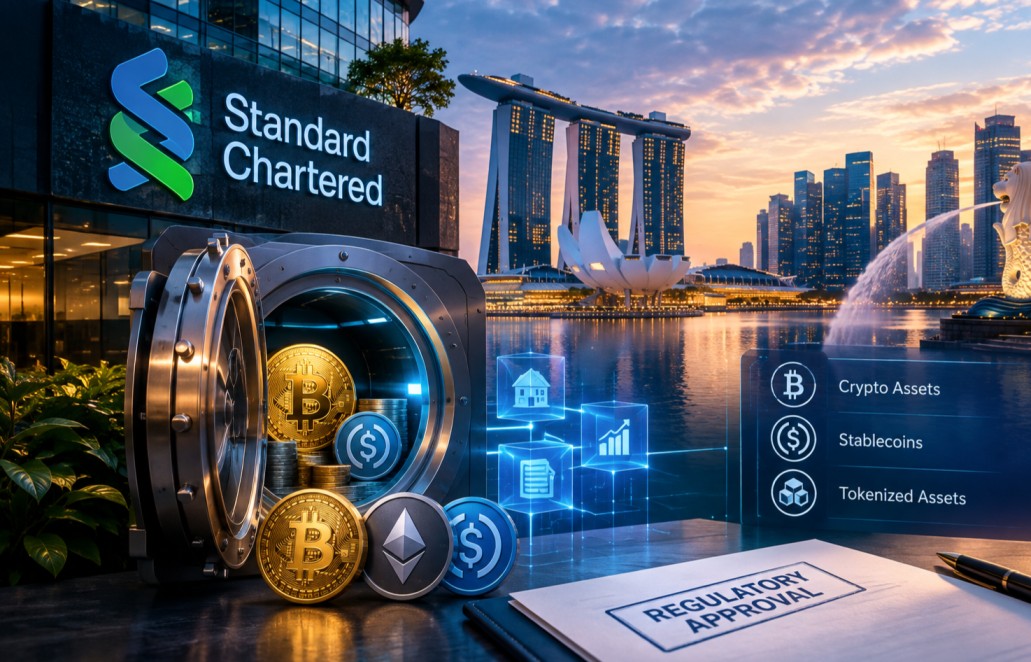
Standard Chartered Eyes Singapore Crypto Custody for Stablecoins and Tokenized Assets, Awaiting Regulatory Approval
Standard Chartered is preparing to expand its institutional digital asset business in Singapore with a planned custody service covering selected crypto assets, stablecoins and tokenized real-world assets. The move highlights the growing role of regulated banks in building infrastructure for the next phase of digital asset adoption.
Standard Chartered Targets Singapore’s Institutional Crypto Market
Standard Chartered is planning to offer digital asset custody services in Singapore for institutional investors and eligible corporate clients. The proposed service is expected to cover selected cryptocurrencies, stablecoins and tokenized real-world assets (RWAs).
However, the service has not yet gone live. The bank’s plan remains subject to applicable regulatory requirements, meaning the timing of the launch will depend on the necessary regulatory process.
The development is significant because Singapore has positioned itself as one of Asia’s key financial and digital asset hubs. For Standard Chartered, entering the Singapore custody market under its own banking brand could strengthen its position in institutional crypto infrastructure.
Why Crypto Custody Is Becoming More Important
Crypto custody is increasingly becoming a critical part of institutional digital asset adoption.
Large investors, banks, asset managers and corporations generally require more than simply buying or selling digital assets. They also need secure asset storage, operational controls, compliance systems and institutional-grade risk management.
This creates an opportunity for traditional financial institutions to become part of the digital asset infrastructure rather than competing only with crypto exchanges.
Standard Chartered has already built capabilities across digital asset custody, trading and tokenization. The bank's digital asset platform lists custody, trading, tokenized deposits and other institutional solutions as part of its broader digital asset strategy.
The planned Singapore service therefore appears to be part of a larger strategy rather than an isolated crypto product launch.
Stablecoins Could Be a Major Part of the Strategy
One of the most important aspects of the announcement is the inclusion of stablecoins.
Stablecoins have increasingly moved beyond their traditional role in crypto trading. They are being explored for payments, settlement, treasury management and cross-border transactions.
Singapore is also working to establish clearer regulatory guardrails around stablecoins. In September, the Monetary Authority of Singapore (MAS) published proposed legislative amendments to implement its stablecoin regulatory framework.
The proposed framework covers issues including value stability, capital requirements, redemption at par, disclosures and customer protection. MAS also highlighted the potential role of regulated stablecoins as settlement assets for tokenized financial markets.
This regulatory direction could be important for banks looking to provide institutional services involving stablecoins.
Tokenized Real-World Assets Add Another Layer
Standard Chartered's planned custody offering also includes tokenized real-world assets, commonly known as tokenized RWAs.
Tokenization involves representing traditional assets or financial instruments as digital tokens on blockchain-based infrastructure. These assets can include securities, funds, money-market products and other financial instruments.
The potential benefit for institutions is not simply putting an asset on a blockchain. The bigger opportunity lies in creating more efficient systems for issuing, transferring, settling and managing financial assets.
However, tokenized assets still require institutional-grade infrastructure. Custody, compliance, asset segregation and cybersecurity become particularly important when traditional financial institutions begin moving regulated assets onto blockchain networks.
Standard Chartered itself has described digital asset custody as an increasingly important layer of financial infrastructure as stablecoins and tokenized assets scale.
Singapore Could Become a Key Institutional Crypto Hub
Singapore's regulatory approach makes the country particularly important for institutional digital assets in Asia.
Rather than treating every digital asset activity in the same way, Singapore has been developing regulatory frameworks around different use cases. Digital payment tokens, stablecoins and tokenized capital-market products can fall under different regulatory requirements depending on the activity involved.
That means regulatory compliance will remain one of the biggest factors determining how quickly Standard Chartered can roll out its planned custody service.
For institutions, this can actually become an advantage.
A regulated environment can provide greater clarity around asset protection, operational risk and compliance. That may make banks more comfortable offering digital asset services to corporate and institutional clients.
Standard Chartered's Broader Digital Asset Expansion
The Singapore announcement comes as Standard Chartered continues expanding its digital asset footprint globally.
The bank has already been involved in institutional crypto custody in Hong Kong. In May 2026, Standard Chartered announced its support for an institutional crypto custody arrangement with SOLOWIN HOLDINGS, marking what it described as the first institutional crypto custody service in Hong Kong offered by a Global Systemically Important Bank.
The bank has also been expanding its broader digital asset infrastructure through custody, trading and tokenization-related businesses.
This suggests that Standard Chartered is positioning itself around the infrastructure layer of the digital economy.
What This Could Mean for the Crypto Market
The biggest takeaway is not an immediate impact on Bitcoin or other cryptocurrency prices.
Instead, the development could have a longer-term impact on institutional crypto adoption.
If major banks increasingly provide regulated custody for crypto assets, stablecoins and tokenized assets, institutions may find it easier to participate in digital asset markets.
This could potentially lead to:
- Greater institutional confidence in digital assets
- Increased demand for regulated crypto custody
- More integration between traditional finance and blockchain
- Growth in tokenized real-world assets
- Greater use of stablecoins for institutional settlement
- Increased competition among banks and crypto custodians
The trend also suggests that the next phase of crypto adoption may be less about retail speculation and more about financial infrastructure.
The Regulatory Approval Remains the Key Hurdle
Despite the potential, investors should not interpret the announcement as a completed launch.
Standard Chartered has not announced a confirmed go-live date for the Singapore custody service, and the proposed offering remains subject to regulatory requirements. The specific digital assets that will initially be supported have also not been disclosed.
That makes regulatory progress the key development to watch.
Singapore's stablecoin framework is itself evolving, with MAS's latest consultation scheduled to accept feedback until October 16, 2026.
Therefore, the eventual scope and timing of Standard Chartered's Singapore custody offering could depend heavily on how the regulatory environment develops.
CoinGroww Analysis
Standard Chartered's Singapore expansion reflects a broader shift taking place across the crypto industry.
The institutional market increasingly needs regulated custody, compliant settlement and secure infrastructure, rather than simply another platform for trading digital assets.
Singapore is particularly important because it sits at the intersection of traditional finance, fintech and Asia's growing digital asset ecosystem.
For Standard Chartered, offering custody for crypto assets, stablecoins and tokenized RWAs could help the bank capture demand from institutions moving into blockchain-based financial products.
The more important question now is not whether traditional banks will participate in crypto, but how deeply they will become integrated into the digital asset infrastructure.
If regulatory approval progresses and institutional demand continues growing, Singapore could become another important market where traditional banking infrastructure and blockchain-based finance converge.
Overall, the announcement is strategically bullish for institutional digital asset adoption, although it should not be viewed as an immediate bullish catalyst for cryptocurrency prices. The real significance lies in the gradual institutionalization of crypto custody, stablecoins and tokenized assets.
Conclusion
Standard Chartered's planned Singapore crypto custody service represents another step in the convergence of traditional banking and digital assets.
By targeting institutional clients and covering crypto assets, stablecoins and tokenized real-world assets, the bank is positioning itself for a financial market where blockchain-based assets could become increasingly integrated with traditional capital markets.
For now, regulatory approval remains the critical next step. But if the service launches successfully, it could further strengthen Singapore's position as an institutional digital asset hub and reinforce the broader trend of banks building infrastructure around the crypto economy.
Disclaimer: This article is for informational and educational purposes only and should not be considered financial or investment advice. Cryptocurrency and digital asset markets are highly volatile and involve significant risk.