Top AI Agents in Crypto 2026: The Projects Redefining What Blockchain Can Do
AI agents in crypto are autonomous software systems that can execute trades, manage portfolios, analyse markets, and interact with blockchain protocols without human input, and in 2026 the projects building the infrastructure for this emerging economy represent some of the most fundamentally compelling investments in the entire digital asset space.
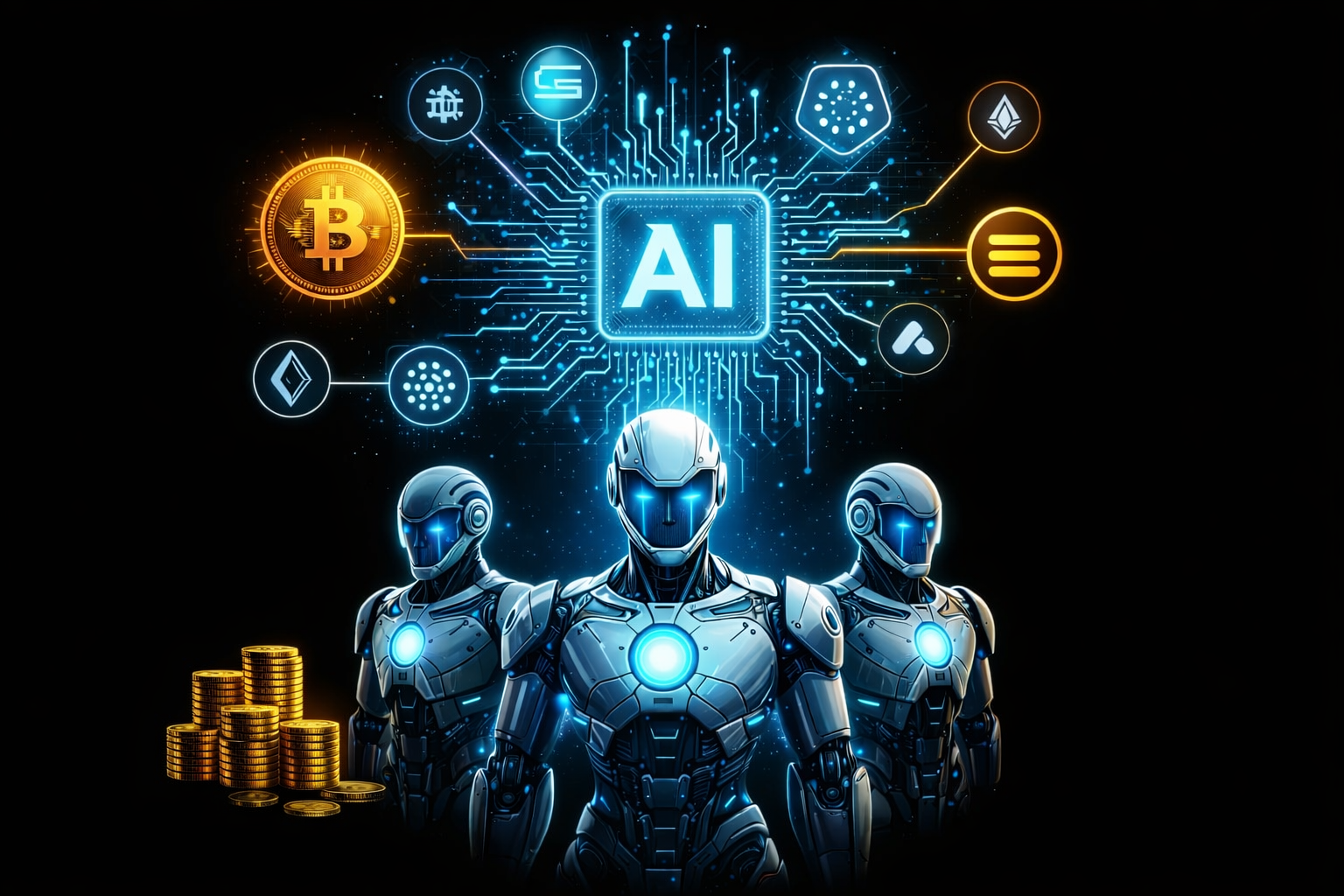
Two of the biggest technological trends of the decade are colliding in real time. Artificial intelligence is reshaping how software works. Blockchain is reshaping how value moves. Where they meet, a new category of crypto project has emerged: AI agents, autonomous systems that can perceive their environment, make decisions, and take actions on-chain without waiting for a human to press a button.
The total market cap of the AI agents sector sits at approximately $2.67 billion as of March 2026, having survived a sharp correction from its 2025 highs to consolidate around projects with genuine infrastructure rather than pure narrative. The best AI crypto coins in 2026 are led by Bittensor (TAO) at a $3.4 billion market cap, followed by NEAR Protocol, Render Network, and the Artificial Superintelligence Alliance. Here is what each major project actually does and why it matters.
What Is a Crypto AI Agent?
A crypto AI agent is an autonomous software programme that can analyse information, make decisions, and execute transactions on a blockchain without requiring human input for each action. Unlike a simple trading bot that follows fixed rules, an AI agent learns, adapts, and responds to changing conditions using machine learning and large language model capabilities.
An AI agent is a virtual assistant that can analyse information, collect and rank news, perform technical analysis, and assist with crypto project research, turning scattered chaotic information into understandable structured data. Applied to blockchain, this means agents that can manage DeFi positions, execute arbitrage strategies, monitor on-chain events, and interact with smart contracts at machine speed, around the clock, without fatigue or emotional bias.
The deeper implication is that AI agents need infrastructure to operate: compute power, data access, payment rails, and coordination mechanisms. That infrastructure is what the leading crypto AI projects are building.
1. Bittensor (TAO)
Bittensor is essentially a decentralised machine learning network that allows AI models to collaborate, compete, and get rewarded based on their performance. Instead of training models in closed silos, Bittensor lets developers contribute models to an open network where they are ranked and compensated in TAO.
The project addresses one of the most significant structural problems in AI: the concentration of compute and model development inside a handful of trillion-dollar companies. Bittensor creates an open marketplace where any developer can contribute intelligence and earn rewards, and where any buyer can access AI services without going through a centralised intermediary.
With a market cap of $3.44 billion and a growing ecosystem of subnets covering everything from text generation to image recognition, Bittensor is the most established large-cap play on decentralised AI infrastructure in 2026.
2. Virtuals Protocol (VIRTUAL)
Virtuals Protocol has become the leading platform for deploying and owning tokenised AI agents, allowing users to create, launch, and co-own AI entities that can interact autonomously across gaming, social media, and DeFi applications. aiXbt by Virtuals analyses trading-related data and broader social trends and automatically publishes its findings on X, amassing over 445,000 followers.
The project combines the AI agent economy with token ownership mechanics: each AI agent deployed on Virtuals has its own token, and holders share in the agent's economic activity. VIRTUALS tokens cover deployment fees for AI agents and grant governance rights, with users able to convert tokens to xVirtual for staking rewards.
Despite strong conceptual differentiation, token concentration among founders and recent price volatility are risks worth weighing carefully before entering a position.
3. Artificial Superintelligence Alliance (FET)
The Artificial Superintelligence Alliance is a merger of Fetch.ai, OCEAN Protocol, CUDOS, and SingularityNET into a single ASI token, making it the world's largest open-source initiative dedicated to decentralised artificial general intelligence.
The combined entity brings together complementary strengths: Fetch.ai's autonomous agent tools for logistics and mobility, SingularityNET's AI service marketplace, and Ocean Protocol's data monetisation infrastructure. Together they form the most comprehensive full-stack decentralised AI platform in the crypto space.
The primary use cases include serving as a decentralised AI marketplace, supporting autonomous AI agents, acting as a payment mechanism for computational power, staking, and governance. For investors who want broad exposure to the decentralised AI theme through a single asset, FET offers the widest coverage of any single token in the sector.
4. Render Network (RENDER)
Render provides GPU power for AI workloads, allowing anyone to rent GPU computing capacity for tasks ranging from 3D rendering to training AI models, with no centralised middleman taking a cut of the transaction.
The mechanics are elegant in their simplicity. A user needing GPU compute deposits RENDER tokens into a smart contract. An operator with available GPU capacity picks up the job, completes the work, submits proof of completion, and receives the tokens automatically. The network verifies everything on-chain.
Data infrastructure projects like The Graph and Grass power the information pipelines that AI models depend on, while GPU networks like Render decentralise the compute layer that underlies all AI workloads. As demand for AI compute continues to grow, Render's position as the decentralised alternative to centralised cloud providers becomes increasingly strategic.
5. NEAR Protocol (NEAR)
NEAR Protocol is positioning itself as the blockchain for AI, creating the infrastructure AI needs to transact, operate, and interact across Web2 and Web3, combining User-Owned AI, Intents, and Chain Abstraction to eliminate blockchain complexity for AI agents operating across multiple networks.
The project's vision is that AI agents should be able to use blockchain rails the way humans use the internet: without needing to understand the underlying infrastructure. NEAR's chain abstraction layer makes it possible for an AI agent to interact with any blockchain without managing separate wallets, bridging assets, or understanding the technical differences between networks.
NEAR aims to empower agents to operate independently without restricted conditions while remaining secure and maintaining privacy, bringing AI capabilities beyond basic computing or analysis. With a current price of approximately $1.17 and a market cap of $1.45 billion, NEAR remains one of the more accessible large-cap entry points in the AI infrastructure category.
6. The Graph (GRT)
Every AI agent operating on-chain needs reliable, structured access to blockchain data. The Graph is the indexing protocol that provides it, allowing developers and AI systems to query blockchain data efficiently through open APIs called subgraphs.
As AI agents increasingly need access to on-chain data, The Graph becomes the go-to protocol for enabling that data layer, essentially serving as the Google for blockchains, something every intelligent system can benefit from.
The Graph's role is infrastructural rather than consumer-facing, which makes it less exciting to follow but potentially more durable as a long-term holding. Every application, agent, or protocol that needs to query blockchain data is a potential user of The Graph's services, giving it one of the broadest potential addressable markets in the AI crypto space.
The Risks Specific to This Sector
The AI crypto sector carries risks beyond standard crypto volatility that are worth understanding explicitly.
The sector has a track record that includes $35 billion in losses during 2025, and faces direct competition from the world's most well-funded technology companies. OpenAI, Google, Amazon, and Microsoft are building centralised AI infrastructure at extraordinary scale, and the question of whether decentralised alternatives can compete on performance and cost is genuinely unresolved.
Token unlock schedules are a persistent concern across the sector. Many AI projects allocated large portions of supply to teams and investors with vesting periods that are now expiring, creating structural sell pressure that can overwhelm buying interest even during favourable market conditions.
The "AI" label has also been applied liberally to projects with minimal genuine AI integration, making it essential to evaluate whether a project's AI capabilities are core to its functionality or decorative branding designed to attract attention during a hot narrative cycle.
The Bigger Picture
Unlike the purely narrative-driven cycles of the past, the top projects in this space are backed by real infrastructure, proven teams, and growing enterprise demand for decentralised AI compute. The concentration of AI capability inside a handful of companies, with OpenAI alone valued at $730 billion following a $110 billion funding round in February 2026, creates a genuine structural argument for decentralised alternatives that did not exist in earlier crypto cycles.
The projects worth owning in this space are those where live utility drives token value rather than marketing narratives. Bittensor, Render, NEAR, FET, and The Graph all have real products, real users, and real revenue. That foundation does not eliminate risk, but it distinguishes them from the vast majority of tokens wearing the AI label in 2026.
Frequently Asked Questions
1. What is the difference between an AI agent and a crypto trading bot? A trading bot follows fixed rules, while an AI agent learns, adapts, and makes autonomous decisions using machine learning, able to interact with any on-chain protocol rather than just executing pre-programmed strategies.
2. Which AI crypto project has the largest market cap in 2026? Bittensor (TAO) leads the AI crypto sector with a market cap of approximately $3.44 billion as of March 2026, followed by NEAR Protocol and Render Network.
3. Are AI crypto tokens a good investment in 2026? Projects with genuine AI utility and real protocol revenue offer more durable investment cases than narrative-only tokens, though the entire sector carries high volatility and significant competition from centralised AI companies.
4. How do AI agents use cryptocurrency to operate? AI agents use crypto tokens to pay for compute resources, access data, execute transactions, and reward contributors within decentralised networks, enabling autonomous economic activity without centralised intermediaries.
5. Where can I buy AI crypto tokens like TAO, RENDER, and FET? All major AI crypto tokens are available on leading exchanges including Binance, Coinbase, and Kraken, with availability varying by region depending on local regulations.
Disclaimer: This article is for informational purposes only and does not constitute financial or investment advice. AI crypto tokens are highly volatile and carry significant risk of loss. Always do your own research before making any investment decisions.
Tags: AI Agents Crypto 2026, Bittensor TAO, Virtuals Protocol, Render Network, NEAR Protocol, FET ASI Alliance, The Graph GRT, AI Crypto Coins, Decentralised AI, Best AI Crypto 2026