Bitget Expands Tokenized Stock Trading With New rToken Transfer Service and Super Match
Bitget expands its RWA ecosystem with rToken Stock Transfer for 3,000+ US stocks and ETFs and Super Match, a new liquidity framework designed to improve trading execution and price discovery.
Introduction
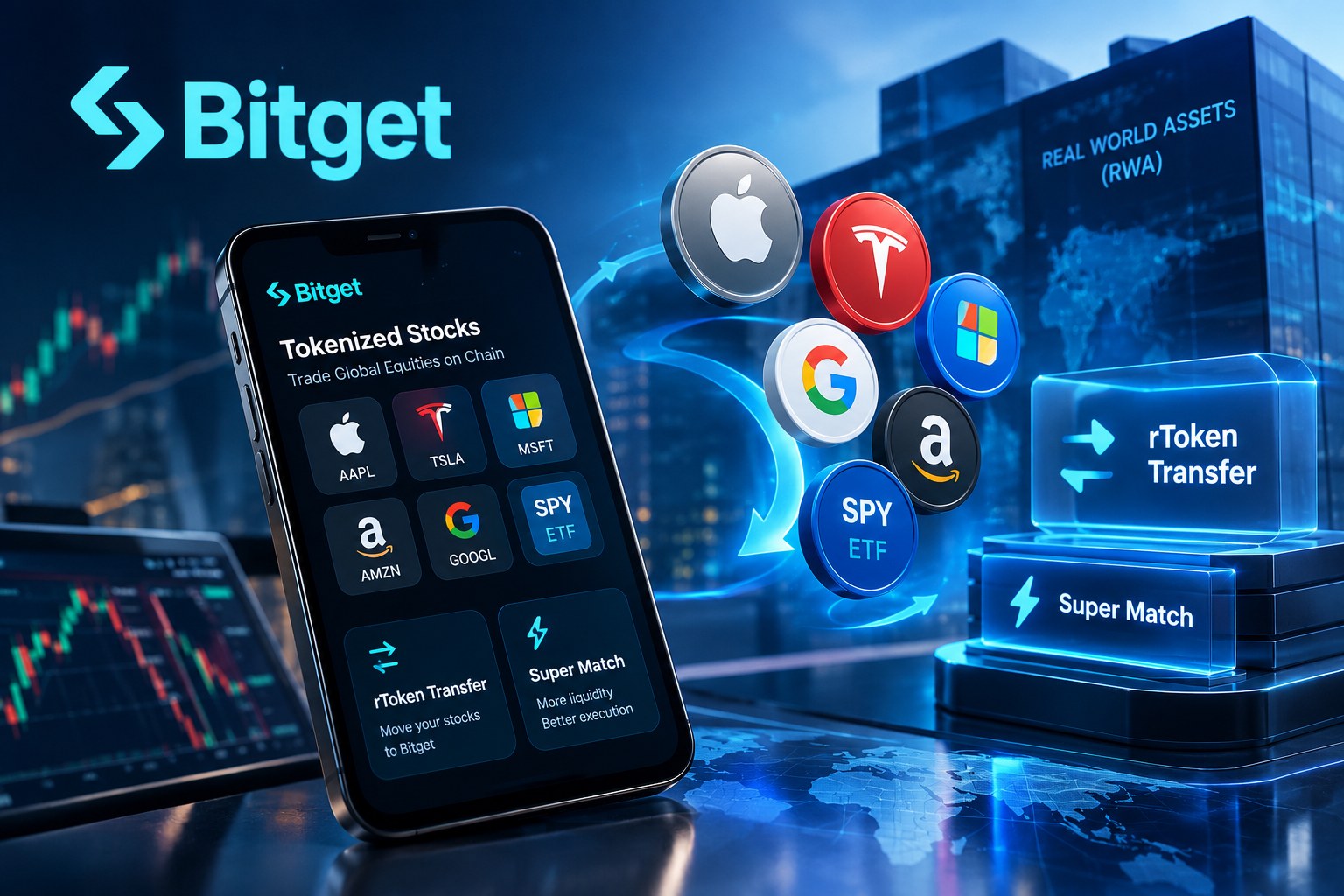
Bitget is expanding its real-world asset (RWA) strategy by connecting traditional stock investments with its digital asset trading ecosystem. The crypto exchange has introduced its rToken Stock Transfer service alongside its Super Match liquidity framework, targeting two key challenges in tokenized finance: transferring existing stock holdings into digital markets and improving trading liquidity.
The rToken Transfer service, launched on October 13, 2026, supports more than 3,000 eligible US-listed stocks and exchange-traded funds (ETFs). Meanwhile, Super Match is designed to connect internal trading activity, market makers and multiple liquidity sources to improve order execution and price discovery.
Together, these developments reflect Bitget’s broader ambition to bring traditional financial assets and cryptocurrency markets closer through its Universal Exchange (UEX) strategy.
Bitget Introduces rToken Transfer for More Than 3,000 Stocks and ETFs
Bitget’s rToken Stock Transfer service allows eligible users to move supported US-listed stocks and ETFs from external brokerage accounts into its platform without first selling their holdings.
After the securities arrive and are processed, Bitget’s In-Kind Tokenization Network (ITN) converts them into corresponding tokenized assets, known as rTokens, which are credited to the user’s Bitget spot account.
The process uses a Free of Payment (FOP) securities transfer to Bitget’s designated Alpaca omnibus account. According to the exchange, incoming transfers carry no transfer fee charged by Bitget, although an external broker may impose its own fees. The estimated processing time is approximately 10 business days.
The service is intended to simplify the transition between traditional equity investments and digital asset platforms. Rather than liquidating eligible stock positions and separately funding a crypto account, users can transfer qualifying securities into the rToken ecosystem, subject to the platform’s eligibility requirements.
However, the service does not cover every stock or brokerage account. Supported assets, account verification, transfer requirements and regional restrictions determine whether an investor can use the feature.
What Is Bitget Super Match and How Could It Improve Liquidity?
While rToken Transfer focuses on bringing traditional securities into Bitget, Super Match addresses what happens after those assets enter its trading ecosystem.
Super Match is an internal liquidity-matching framework designed to connect Bitget’s trading engine with multiple market makers and liquidity sources. During supported trading activity, orders can be matched internally before unmatched quantities are routed to an external broker.
This structure is intended to improve liquidity depth, order execution and price discovery for tokenized stocks.
For traders, liquidity matters because thin order books can lead to wider bid-ask spreads, slippage and less favorable execution prices. Bringing more market participants and liquidity sources into the same framework could help address these issues as rToken trading activity grows.
Bitget’s Super Match rollout reached its stated full deployment milestone on October 20, 2026, according to its support documentation.
However, a new matching system does not automatically guarantee tighter spreads or better execution for every trade. Actual results will depend on market conditions, available counterparties, order size and the liquidity of individual assets.
Why Bitget Is Focusing on Real-World Asset Tokenization
Real-world asset tokenization involves representing traditional financial or physical assets through digital tokens. In financial markets, tokenized stocks and ETFs aim to connect exposure to conventional securities with blockchain-based infrastructure.
The sector has attracted attention because tokenization could make financial assets more accessible across digital platforms and create additional ways to manage capital.
For Bitget, expanding rToken transfers and liquidity infrastructure represents a move beyond simply listing tokenized equities. The broader objective is to make these assets more useful within an integrated trading ecosystem.
Depending on asset eligibility and applicable product terms, supported rTokens may be available for spot trading and certain additional services, including margin-related functions, borrowing and lending, and yield products.
These potential uses could increase the utility of tokenized assets. Nevertheless, availability varies by product and jurisdiction, and investors should not assume that every rToken supports all financial functions.
How the Development Fits Into Bitget’s Universal Exchange Strategy
Bitget’s Universal Exchange strategy seeks to bring cryptocurrency trading, tokenized traditional assets and other financial products into a more unified platform.
The combination of broker interoperability and Super Match addresses two different parts of that strategy.
First, rToken Transfer creates a route for eligible securities held outside the crypto ecosystem to enter Bitget. Second, Super Match aims to improve the infrastructure through which those tokenized assets are traded.
This approach could help reduce the separation between traditional brokerage portfolios and digital asset markets. It may also create opportunities for greater institutional participation if market makers and other liquidity providers find the system commercially attractive.
The longer-term potential depends on several factors, including regulatory clarity, transparent asset backing, reliable custody arrangements, competitive trading costs and consistent liquidity.
In other words, expanding the number of available tokenized stocks is only one part of building a sustainable RWA market. The ability to trade those assets efficiently and understand the rights attached to each token will be equally important.
Key Challenges and Risks for Tokenized Stock Trading
Despite the potential benefits, Bitget’s latest developments face challenges common to the wider tokenized asset industry.
Liquidity consistency: More liquidity sources may improve execution, but market depth can still vary across assets and market conditions.
Regulatory restrictions: Access to tokenized securities and related services depends on jurisdiction-specific rules and platform eligibility requirements.
Asset and custody structure: Investors should understand how each rToken relates to the underlying security, including custody arrangements, redemption or transfer conditions, and applicable investor protections.
Fees and transfer timelines: Although Bitget does not charge an incoming transfer fee, external broker fees and processing delays may affect the overall experience. Outgoing transfers may also incur charges.
Market access versus ownership rights: Tokenized exposure should not automatically be treated as identical to holding conventional shares directly in a brokerage account. Investors should review the specific terms and rights associated with each product.
These factors will influence whether tokenized stock platforms can attract long-term users beyond short-term trading demand.
What Bitget’s RWA Expansion Means for the Crypto Market
Bitget’s rToken Transfer and Super Match initiatives highlight a broader shift in crypto market infrastructure. Exchanges are increasingly looking to connect digital asset trading with traditional financial markets instead of relying exclusively on cryptocurrency-native products.
If the approach gains traction, tokenized equities could become a more integrated part of digital trading platforms, with improved access to liquidity and additional ways to use eligible assets.
For the wider RWA sector, the important measure of progress will not simply be the number of tokenized stocks listed. Sustainable growth will also require reliable execution, transparent asset structures, strong compliance processes and practical utility for investors.
Bitget’s latest initiatives provide a framework for pursuing these goals, but their long-term impact will depend on adoption, market depth and the performance of the underlying infrastructure.
Conclusion
Bitget’s expansion of tokenized stock trading combines easier access to eligible traditional securities with a new approach to liquidity management. The rToken Stock Transfer service supports more than 3,000 eligible US-listed stocks and ETFs, while Super Match is designed to improve order matching and price discovery.
The developments strengthen Bitget’s broader RWA strategy and its effort to unite traditional financial assets with cryptocurrency markets. However, sustained adoption will depend on real-world execution quality, regulatory compliance, asset transparency and the practical benefits delivered to users.
As tokenization continues to evolve, Bitget’s progress could offer a useful indication of how crypto exchanges are building infrastructure for the next phase of digital financial markets.
Disclaimer: This article is for informational and educational purposes only and does not constitute financial or investment advice. Tokenized assets involve market, liquidity, regulatory and counterparty risks. Readers should review the relevant product documentation before making investment decisions.