
Top AI Crypto Projects to Watch in 2026
An in-depth research guide covering the most promising AI-powered blockchain projects, market trends, investment considerations, and the future of decentralized intelligence in 2026.

2026 Investor & Web3 Research Report
Introduction
Artificial Intelligence (AI) and blockchain technology are converging at an unprecedented pace in 2026. While AI dominates enterprise and consumer software innovation, blockchain provides decentralized coordination, transparency, and token-based incentive systems. Together, they are enabling new forms of digital economies powered by autonomous agents, decentralized compute markets, and trust-minimized data sharing.
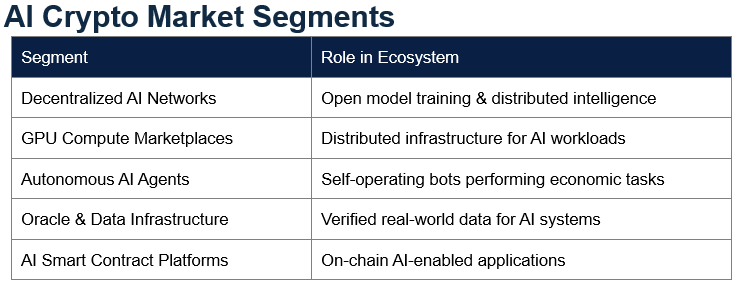
AI crypto projects are no longer experimental concepts. They are actively building infrastructure for decentralized model training, GPU-sharing networks, AI-powered smart contracts, and on-chain automation. Below is a comprehensive analysis of the leading AI crypto ecosystems to watch in 2026.
Bittensor (TAO)
Bittensor operates as a decentralized machine learning network where participants contribute models and are rewarded based on the value they provide to the ecosystem. Instead of centralized AI labs controlling model development, Bittensor incentivizes open-source intelligence creation. Its token TAO coordinates network participation and rewards performance-based contributions.
Fetch.ai (FET)
Fetch.ai builds autonomous economic agents capable of executing real-world tasks such as trading, data exchange, supply chain optimization, and digital negotiations. These agents interact independently across decentralized networks, creating AI-driven automation economies.
Render (RNDR)
Render provides decentralized GPU infrastructure, enabling users to rent out excess GPU capacity for AI model training and rendering tasks. As AI demand surges, decentralized compute markets like Render help reduce dependency on centralized cloud providers.
Internet Computer (ICP)
Internet Computer is a high-performance Layer-1 blockchain designed to host scalable AI-native applications directly on-chain. It supports smart contracts capable of integrating AI logic, allowing developers to build decentralized AI-powered dApps.
Chainlink (LINK)
Chainlink supplies decentralized oracle services that feed secure, real-world data into smart contracts. For AI-driven blockchain systems, trusted data inputs are critical. Chainlink acts as infrastructure connecting off-chain intelligence to on-chain logic.
NEAR Protocol (NEAR)
NEAR is a scalable and developer-friendly blockchain ecosystem supporting AI and Web3 integrations. Its focus on usability, interoperability, and performance makes it attractive for AI-powered decentralized applications and automation frameworks.
How to Evaluate AI Crypto Projects in 2026
• Assess real-world utility and long-term problem-solving capacity.
• Examine tokenomics and sustainability of reward mechanisms.
• Analyze developer activity, GitHub commits, and ecosystem growth.
• Review partnerships with AI labs, enterprises, and Web3 ecosystems.
• Consider regulatory environment and compliance readiness.
Future Outlook: AI + Blockchain Beyond 2026
The convergence of AI and blockchain could redefine digital coordination systems. From decentralized AI agents managing DeFi protocols to open data marketplaces powering global machine learning collaboration, the infrastructure built in 2026 may influence the next decade of Web3 growth.
Disclaimer: This research report is for informational purposes only and does not constitute investment advice. Cryptocurrency markets are volatile and carry significant risk. Readers should conduct independent research before making financial decisions.