
How Does Bitcoin Mining Work? Complete Guide to BTC Creation and Network Security
Bitcoin mining is the process that helps confirm transactions, secure the blockchain and introduce new BTC into circulation. Here’s how Proof of Work, mining hardware, rewards and difficulty work together.
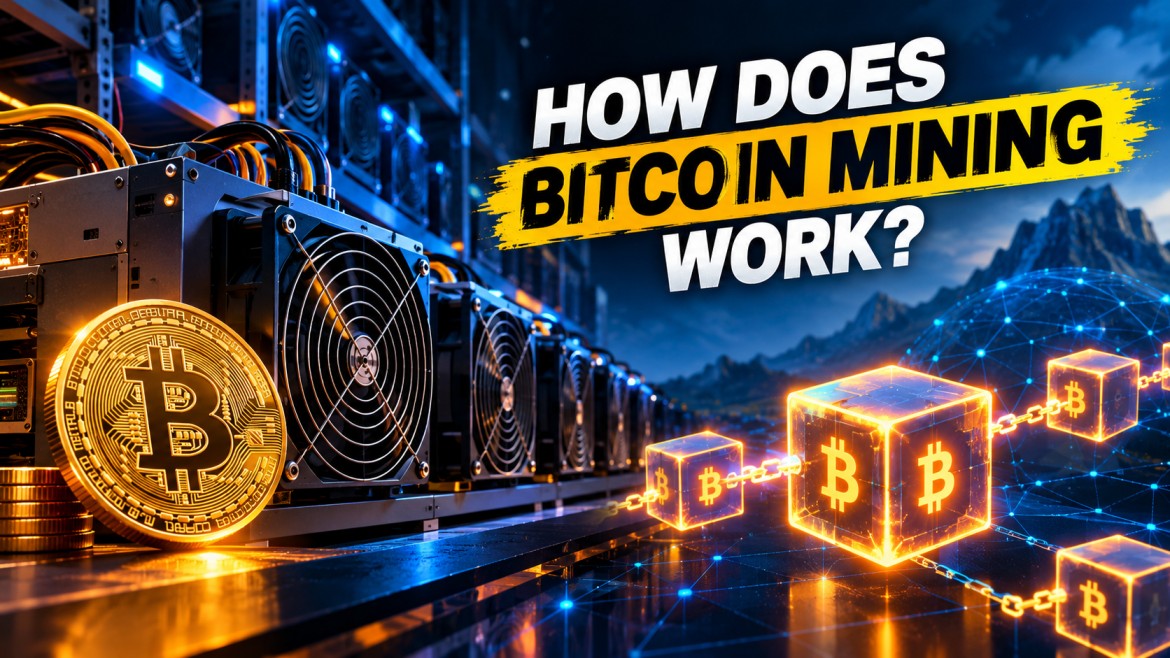
What Is Bitcoin Mining?
Bitcoin mining is the process through which transactions are confirmed and added to the Bitcoin blockchain. Miners use specialized computing hardware to compete for the opportunity to add the next block of transactions to the network.
Mining serves two important purposes. It helps maintain the security and consensus of the Bitcoin network, while also distributing newly created Bitcoin according to the protocol's rules.
Unlike traditional currencies, Bitcoin does not have a central authority that decides when new coins should be issued. New BTC enters circulation through the mining process.
How Does Bitcoin Mining Work?
Bitcoin uses a consensus mechanism called Proof of Work (PoW).
Miners collect pending transactions and organize them into a candidate block. Their hardware then performs an enormous number of calculations in an attempt to find a valid cryptographic result that satisfies the network's difficulty requirements.
The process is essentially a highly competitive mathematical search. A miner that finds a valid block can broadcast it to the network, where Bitcoin nodes verify that the block follows the protocol rules.
Once accepted, the block becomes part of the blockchain and the transactions inside it receive confirmation.
New Bitcoin blocks are discovered approximately every 10 minutes on average, although individual block times can vary because the process is probabilistic
What Is Proof of Work?
Proof of Work is the mechanism that makes Bitcoin mining difficult to perform but easy for other network participants to verify.
Miners repeatedly change data in a candidate block and calculate hashes until they find a result that meets the required target.
The enormous amount of computing power required makes it expensive to manipulate the blockchain. An attacker attempting to rewrite older transactions would need to redo the computational work for the affected blocks and compete against the continuing network.
This is one of the key reasons mining plays such an important role in Bitcoin's security.
What Hardware Is Used for Bitcoin Mining?
Bitcoin mining has changed dramatically since the network's early years.
In Bitcoin's beginning, ordinary computers could participate in mining. As competition increased, miners moved from CPUs to GPUs and eventually to ASICs, or Application-Specific Integrated Circuits.
ASIC miners are specialized machines designed specifically for Bitcoin's SHA-256 hashing algorithm. Their efficiency gives them a major advantage over general-purpose computers.
Today, mining economics depend heavily on hardware efficiency, electricity costs, cooling infrastructure and the overall competitiveness of the network.
How Do Bitcoin Miners Earn Money?
A Bitcoin miner can receive two main forms of revenue:
Block subsidy: Newly created BTC included in a successfully mined block.
Transaction fees: Fees attached to transactions included in the block.
The current Bitcoin block subsidy is 3.125 BTC, following the April 2024 halving. The subsidy is scheduled to fall to 1.5625 BTC at the next halving, currently estimated for 2028.
This means mining revenue is not determined only by the Bitcoin price. Electricity, hardware efficiency, network difficulty, fees and competition all affect profitability
What Is Bitcoin Mining Difficulty?
Bitcoin automatically adjusts its mining difficulty so that blocks continue to arrive at roughly the intended average rate.
When more computing power joins the network, mining generally becomes more competitive. When significant mining power leaves, the difficulty can adjust in the opposite direction.
This mechanism helps Bitcoin maintain a predictable issuance schedule without requiring a central organization to control the network.
Why Do Most Miners Join Mining Pools?
Finding a Bitcoin block independently can be extremely unpredictable for an individual miner.
A mining pool allows multiple miners to combine their computing power. When the pool successfully mines a block, the resulting rewards are distributed among participating miners according to the pool's rules and contributed work.
Mining pools therefore provide miners with a more regular stream of smaller payouts instead of relying entirely on the chance of discovering a block individually
Is Bitcoin Mining Still Profitable?
Bitcoin mining can be profitable for some professional operators, but profitability is not guaranteed.
Large mining operations generally focus heavily on electricity prices, efficient ASIC hardware, cooling, infrastructure and access to reliable power.
For individuals, buying an ASIC does not automatically mean generating a profit. Electricity costs can quickly consume mining revenue, while hardware becomes less competitive as newer and more efficient machines enter the market.
This is why Bitcoin mining profitability should be calculated using actual operating costs rather than simply looking at the current BTC price.
Why Is Bitcoin Mining Important?
Mining does more than create new Bitcoin.
It helps the network establish the order of transactions, prevents double-spending and makes attempts to rewrite historical blocks increasingly expensive.
The process also supports Bitcoin's predictable monetary policy. The protocol reduces the block subsidy through scheduled halvings until the issuance of new BTC eventually reaches zero, with the maximum supply designed around 21 million Bitcoin.
Final Thoughts
Understanding how Bitcoin mining works makes it easier to understand why the Bitcoin network can operate without a central authority.
Miners provide computing power, process transactions and compete through Proof of Work. In return, successful miners receive block rewards and transaction fees.
As mining becomes more competitive, hardware efficiency and energy costs have become increasingly important. At the same time, mining remains a fundamental part of Bitcoin's security and its controlled supply mechanism.
Bitcoin mining is therefore not simply a way to create new BTC. It is one of the core systems that allows the Bitcoin blockchain to remain decentralized, verifiable and resistant to manipulation.
Disclaimer: This article is for informational and educational purposes only and does not constitute financial or investment advice. Bitcoin mining involves significant hardware, electricity, market and operational risks. Always conduct your own research before making financial decisions