Bitcoin vs Ethereum (2026): The Definitive Comparison Guide
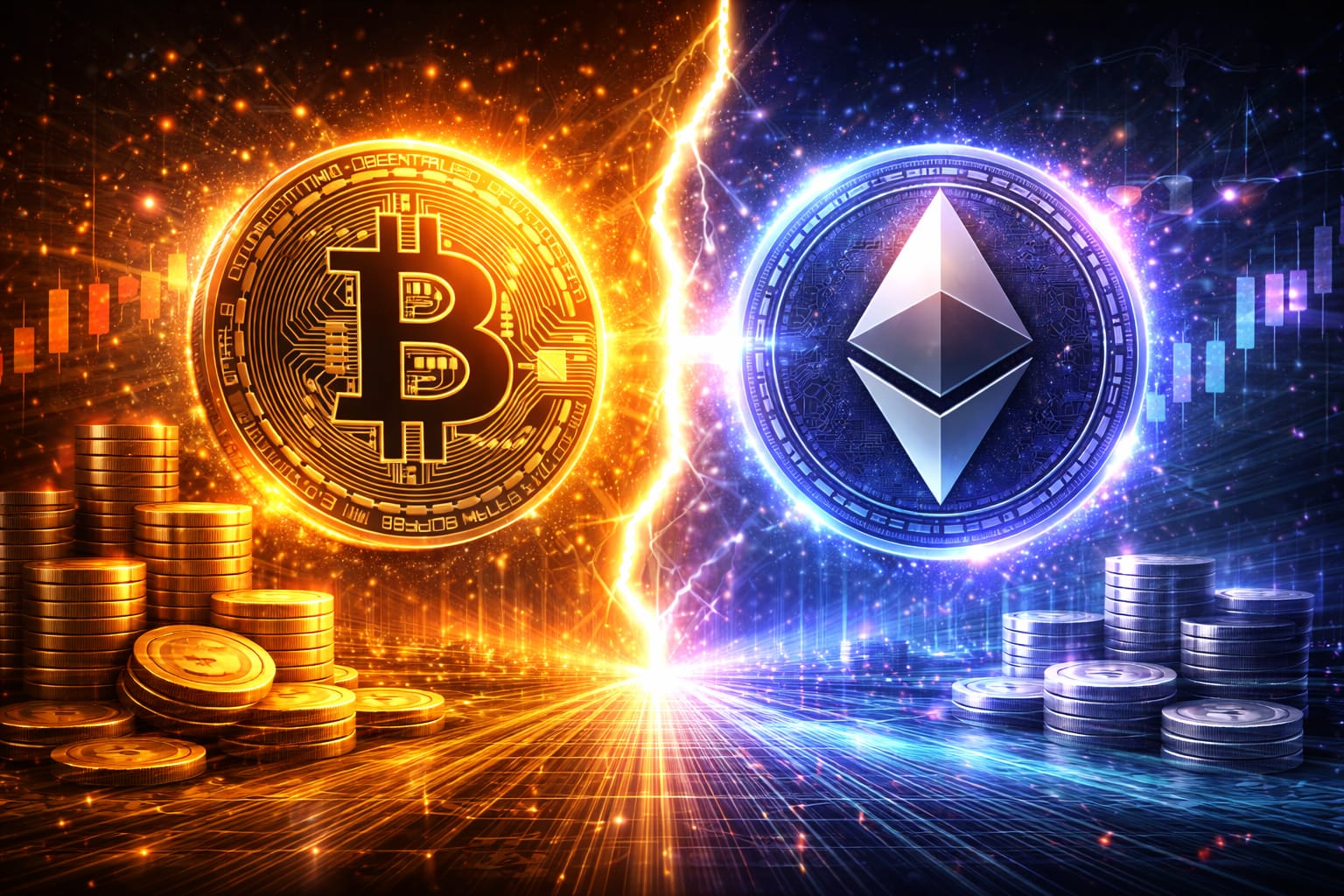
Bitcoin and Ethereum are the two dominant forces in the crypto universe but they were built for entirely different purposes. Understanding that difference is the foundation of every smart crypto decision in 2026.
Introduction
Bitcoin and Ethereum are the two dominant forces in the crypto universe but they were built for entirely different purposes. Understanding that difference is the foundation of every smart crypto decision in 2026.
Key Insight: Bitcoin and Ethereum are not really competitors in the traditional sense. They solve different problems. BTC is the monetary layer; ETH is the application layer of the emerging decentralised internet.
2. Technology: How They Actually Work
Bitcoin. Simplicity as Strength
Bitcoin's blockchain is intentionally simple. Its scripting language is deliberately limited, which minimises attack surfaces and maximises security. This philosophy is often compared to building a rocket: every change is exhaustively reviewed for reliability before it ships. Recent Bitcoin Core releases (v28.4, v29.3, v30.2 in early 2026) focused on fixes and hardening rather than new features.
Scalability is handled off-chain via the Lightning Network, a Layer-2 solution enabling near-instant, low-cost micro-transactions. By 2025, the Lightning Network supported advanced micropayment use cases not previously possible at the base layer.
Bitcoin 2026 Highlight: The Lombard team introduced Bitcoin Smart Accounts in February 2026, allowing BTC held in custody to be used as on-chain collateral for lending and decentralised exchanges. A sign that Bitcoin is quietly extending its utility without changing its core protocol.
Ethereum. Programmability as Power
Ethereum's blockchain is Turing-complete, meaning it can run arbitrarily complex programs called smart contracts. Self-executing code that powers everything from DeFi lending protocols and decentralised exchanges to NFT markets and on-chain governance.
In 2022, Ethereum completed "The Merge," transitioning from energy-hungry Proof of Work to Proof of Stake, reducing energy consumption by an estimated 99%+. In 2026, the Ethereum Foundation is pushing further: post-quantum security research launched at pq.ethereum.org in March 2026, Layer-2 scaling through rollups (Arbitrum, Base, Optimism) handles the bulk of transactions, and Aave V4 went live on mainnet in March 2026.
Ethereum 2026 Highlight: Ethereum is roughly 20% through its post-quantum resistance roadmap, with the Ethereum Foundation actively researching cryptographic upgrades to future-proof the network against quantum computing threats.
3. Supply & Tokenomics: The Scarcity Question
Bitcoin Max Supply: 21M BTC Hard-coded. Never changes. Approximately 20 million already mined as of early 2026.
Ethereum Supply Model: Flexible No hard cap. EIP-1559 burns fees. Can be net deflationary during high activity.
Bitcoin's scarcity is its headline feature. There will only ever be 21 million BTC. A fact embedded in the protocol's DNA. This is reinforced by halving events every four years, which cut the rate of new BTC issuance in half. The April 2024 halving reduced daily issuance from 900 BTC to just 450 BTC, dropping the annual inflation rate to approximately 0.83%.
Ethereum's supply model is more nuanced. While there is no hard cap, the EIP-1559 upgrade introduced a fee-burning mechanism that permanently removes ETH from circulation every time a transaction occurs. During periods of high network activity, this burning can outpace new issuance, making ETH net deflationary. However, the rise of Layer-2 networks in 2025–2026 reduced base-layer fee revenue significantly, meaning ETH is currently net inflationary again.
4. Use Cases: What Are They Actually For?
What Bitcoin Is Used For
Bitcoin's dominant role in 2026 is as a store of value. A hedge against inflation and currency debasement. It functions as digital gold: finite, portable, censorship-resistant, and not controlled by any government or central bank. It is increasingly held in corporate treasuries, sovereign reserves, and investment portfolios alongside traditional safe-haven assets.
For payments, Bitcoin's Lightning Network enables fast, cheap micro-transactions, particularly relevant in regions with unstable currencies or limited banking access.
What Ethereum Is Used For
Ethereum is the backbone of the decentralised internet. As of April 2026, Ethereum leads all blockchains in Total Value Locked (TVL) in DeFi at $55 billion, nine times higher than the second-place network, Solana. This encompasses lending and borrowing protocols, decentralised exchanges, stablecoins, and yield farming.
Beyond DeFi, Ethereum powers the emerging tokenisation of real-world assets (RWA), bringing traditional financial instruments like bonds, real estate, and equities onto the blockchain. It also remains the primary platform for NFTs, DAOs, and Web3 application development.
Simple Mental Model: Bitcoin = digital money and a savings account for value. Ethereum = a programmable financial operating system. You don't compare them the same way you'd compare gold to the New York Stock Exchange.
5. Price Performance: 2025–2026
Both assets had a dramatic arc over the past 18 months. Bitcoin rose roughly 16% in the period following the April 2024 halving through early 2025, while Ethereum dropped nearly 50% over the same period. A sharp divergence that surprised many investors.
Both assets hit all-time highs in the second half of 2025, before a significant market correction in early 2026. In the February 2026 crypto crash, Bitcoin demonstrated relative resilience: BTC fell less than ETH, reflecting its status as the market's "risk anchor." Ethereum, treated as a higher-beta asset, absorbed proportionally more selling pressure.
BTC Price (April 2026): ~$74,000 Down ~42% from its 2025 all-time high of ~$126,000. Trading around $66K–$74K in late March/early April 2026.
ETH Price (April 2026): ~$2,300 Down ~53% from its 2025 all-time high of ~$4,946. Higher drawdown than BTC.
10-year perspective: Bitcoin has returned approximately 16,200% over the past decade as of April 2026. Ethereum has shown even more dramatic cycles, peaking at ~3,000% above its March 2019 value by mid-2021 before significant corrections.
Disclaimer: Past performance is not a guarantee of future results. Cryptocurrency is highly volatile. Price figures here are approximate and for informational context only. This is not financial advice.
6. Institutional Adoption in 2026
Institutional interest has reshaped both assets, but in different ways.
For Bitcoin, the 2024 approval of US spot Bitcoin ETFs was a watershed moment. By early 2026, US spot Bitcoin ETFs held total net assets of approximately $91.83 billion, with cumulative net inflows of $56.14 billion since launch. Strategy (formerly MicroStrategy) alone holds over 761,000 BTC. Bitcoin is increasingly finding its way into corporate treasuries and, in some cases, sovereign reserves.
Ethereum's institutional story is centred on utility. It dominates the DeFi and asset tokenisation sectors. The infrastructure layer that financial institutions are building on. BlackRock's iShares Ethereum Trust ETF provides institutional access to ETH, and major institutions are deploying capital into Ethereum-based real-world asset (RWA) tokenisation. ARK Invest's Big Ideas 2026 report projects Ethereum's market cap could grow at a compound annual rate of 54% through the end of the decade, though such projections carry significant uncertainty.
7. Key Risks to Understand
Risks Specific to Bitcoin
Quantum computing threat: Google estimates a future quantum computer could crack Bitcoin private keys in as little as 9 minutes. Unlike Ethereum, Bitcoin has not publicly disclosed post-quantum transition plans as of early 2026.
Limited native programmability: Bitcoin relies on sidechains and Layer-2 solutions for expanded use cases, adding complexity and trust assumptions at the edges.
Regulatory risk: As a monetary alternative, Bitcoin may face heightened scrutiny from governments and central banks.
Risks Specific to Ethereum
L2 cannibalisation: Layer-2 networks like Base, Arbitrum, and Optimism handle most transactions, reducing base-layer fee revenue. Weekly base-layer fees have fallen to ~$2.3M vs. a peak of $30M.
Execution risk: Ethereum's ambitious roadmap, sharding, post-quantum upgrades, L2 integration, must be delivered successfully.
Higher beta: ETH experiences larger drawdowns than BTC during risk-off market events, as seen in February 2026.
Shared Risks
Macroeconomic headwinds: elevated interest rates and geopolitical uncertainty weigh on all risk assets.
Regulatory changes in major jurisdictions can move prices sharply.
Both assets remain highly volatile compared to traditional investments.
8. Which Should You Buy. BTC or ETH?
There is no universal right answer. The better choice depends entirely on your investment thesis, risk tolerance, and time horizon.
Choose Bitcoin if:
You want a simple, battle-tested store of value
You believe in the digital gold narrative
You want lower volatility relative to other crypto
Strong institutional backing matters to you
You want crypto exposure without tracking a complex development roadmap
Choose Ethereum if:
You believe DeFi and Web3 will be transformative
You want exposure to programmable finance infrastructure
A higher volatility / higher upside trade-off suits you
You are comfortable monitoring a technical development roadmap
You want exposure to real-world asset tokenisation
Many experienced investors hold both, treating BTC as their core monetary hedge and ETH as a higher-risk/higher-reward technology bet. That portfolio structure acknowledges that the two assets are genuinely different and complementary.
Frequently Asked Questions
Is Bitcoin better than Ethereum? Bitcoin is better for storing value; Ethereum is better for decentralised apps and DeFi — they serve different purposes.
Which is safer. BTC or ETH? Bitcoin is considered lower risk, as it consistently experiences smaller drawdowns than ETH during market downturns.
Can Ethereum overtake Bitcoin in market cap? It hasn't happened yet, but analysts say it's possible if Ethereum's ecosystem utility continues to grow.
What is the difference between Bitcoin and Ethereum in simple terms? Bitcoin is digital gold for storing value; Ethereum is a programmable blockchain for running decentralised applications.
Should I buy Bitcoin or Ethereum in 2026? Buy Bitcoin for stability and store of value, Ethereum for DeFi and Web3 growth exposure — many investors hold both.|
Disclaimer:
This article is for informational and educational purposes only. It does not constitute financial, investment, or legal advice. Cryptocurrency investments are highly speculative and may result in the total loss of invested capital. Always do your own research (DYOR) and consult a qualified financial professional before investing. Updated April 12, 2026.